

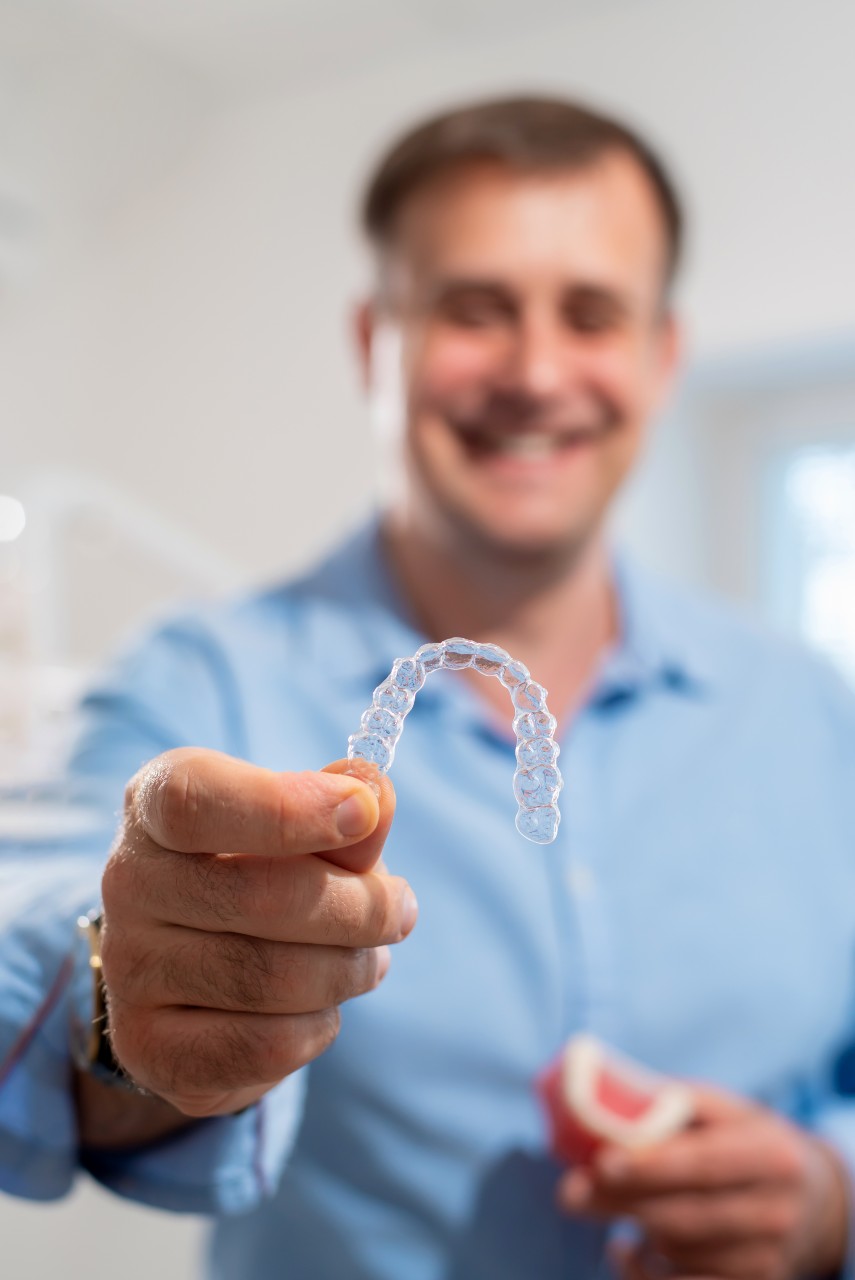
The Science Behind the Smile
Most people think Invisalign is simple: pop in a new set of trays every two weeks, and watch your teeth straighten. It sounds neat, tidy, and predictable, but what’s happening beneath those clear aligners is far more complex.
As an Invisalign Gold provider, Dr. Grewal approaches Invisalign with a deep understanding of how your bone, gums, and tissue respond to movement. Because while aligners are made from plastic, your body is made from living, responsive biology, and it’s that biology that determines how your treatment should progress.
How Teeth Really Move
Every time you switch to a new aligner, it applies gentle, constant pressure to the teeth it’s meant to move. What many people don’t realize is that your teeth aren’t simply sliding through bone – the bone itself is remodelling in response.
Here’s how it works:
- On one side of the tooth, the bone begins to dissolve slightly to make space for movement.
- On the other, new bone starts forming to support the tooth’s new position.
- The gums and ligament fibres surrounding each tooth stretch and compress to stabilise it.
This process, called bone remodelling, happens at a different rate for every person. It’s influenced by everything from age and hormone balance to genetics and overall oral health. In other words, tooth movement is a biological process, not a mechanical one. And biology doesn’t run on a two-week timer.
Why the “Two-Week Rule” Doesn’t Work for Everyone
Invisalign’s standard protocol suggests changing trays every 14 days. It’s a useful starting point, but that’s all it is. Dr. Grewal has seen countless cases where that rhythm doesn’t fit the body’s natural pace.
Some patients’ bone tissue responds quickly, allowing for faster progression. Others need more time for bone and gum adaptation before the next aligner is safe to use. Moving too soon can actually compromise the stability of the result, leading to relapse or gum sensitivity later on.
That’s why at Okanagan Smiles, Dr. Grewal doesn’t treat Invisalign as an automated process. Every treatment is customized, every transition between trays is considered, and every patient’s biology dictates the timeline, not the other way around.
Precision Through Observation
Throughout your treatment, Dr. Grewal monitors subtle indicators of healthy tooth movement:
- Gum response: Watching for inflammation, blanching, or signs of pressure overload.
- Bone stability: Tracking tooth mobility and ensuring new bone has time to form.
- Tissue health: Ensuring aligners aren’t forcing change faster than the body can remodel.
It’s this level of attention that sets Okanagan Smiles apart. Because aligner therapy isn’t just about moving teeth, but also about guiding a living process safely, predictably, and permanently.
Why a Thoughtful Pace Matters
Moving teeth too quickly can look successful in the short term – the smile lines up, the trays fit – but without proper biological adaptation, relapse is common. Bone needs time to rebuild, gum fibres need time to settle, and ligaments need time to hold the new position.
By taking a biologically tuned approach, Dr. Grewal helps patients achieve results that are not only straighter, but stable. That’s what makes the difference between a temporary fix and a lifelong smile.
An Invisalign Gold Provider
At Okanagan Smiles in Kelowna, Invisalign treatment is never a one-size-fits-all program. We’ve earned Gold Provider status because we know Invisalign isn’t about just changing trays every 2 weeks. It’s a guided process rooted in biology, patience, and expertise. Dr. Grewal’s approach respects the body’s natural timing, reducing risks and improving long-term outcomes — because the goal isn’t just to move teeth, it’s to build a smile that lasts.
If you’re considering Invisalign in Kelowna, book a consultation with Dr. Grewal. You’ll see the difference that comes from a dentist who doesn’t just straighten smiles.